

I made a spontaneous trip to San Francisco in the middle of July this summer. I hadn’t visited since I did summer school there when I was 10.

It’s a rather pleasant city. You turn a corner and the street drops away so steeply it feels like it might continue straight into the bay; you climb a few steps and suddenly the water is there, framed between rooftops and telephone wires, shifting with the fog. The city almost seems to reveal itself in fragments rather than panoramas.
I was there, primarily, to visit friends. They, like everyone else in San Francisco, were doing startups. Over the course of the week, I was introduced to parts of their network, consisting of variations of the same person: twenty-something year olds in expensive sneakers and deliberately inexpensive T-shirts, speaking with serene urgency about the AGI revolution, and the inefficiencies that had survived until they noticed them. They worked from converted warehouses or living rooms containing six monitors but nowhere comfortable to sit. Everyone was building something “unprecedented” while also telling some version of the same story: they take a gap year at Stanford because staying would mean they are not escaping the “permanent underclass.” Then, they find a co-founder and move into an apartment with no dining table. They work until the distinction between day and night collapses with the hopes that they will change the world. Or, perhaps, fail in a manner that qualifies them to try again with greater authority.
San Francisco worships individual disruption, but its rebels have developed a strangely uniform idea of revolt. Everyone wants to reject the conventional career in roughly the same way. They use the same language to describe originality, admire the same people for refusing to seek approval, and pursue independence through a culture with its own severe hierarchy of status. Even the insistence that they do not care what anyone thinks of them is expressed through a recognizable collection of habits, references, and ambitions.
San Francisco is populated by people determined to become exceptions as a herd.
On the surface, there is no doubt that there is something very empowering about this. (Especially how the idea of failure no longer closes down possibility! A failed company can still become some kind of a credential or maybe a venture-capital job or perhaps an even more impressive second attempt. Even the word “pivot” promises that nothing ever has to be let go of if it can be absorbed into the narrative of eventual success.)
Quite frankly, as someone who has always considered themselves risk-averse and a stickler for the rules, I just felt very inspired by the whole culture. At Yale, having stumbled into the finance clubs my Freshman fall, I was floored. While my friends were spending their summers exhausted from being pinged at 11pm to build DCF models, only to have Excel crash halfway through, here was an entire city of people throwing themselves headfirst at ideas they appeared genuinely to believe in. They had rejected the deferred gratification on which the conventional career is built: suffer through the internship for the return offer, through the analyst years for the promotion, through the promotion for enough money to eventually retire and move to Miami. In San Francisco, nobody was waiting for permission from some suited higher-up to begin their real life.
But much of this freedom was theatrical. San Francisco glorifies dropping out because it reduces commitment into a single, dramatic moment, a compressed cinematic sequence (Nolan style, perhaps) of the leave-of-absence form, the announcement that there is now no alternative but to succeed (often via an AI-generated LinkedIn post), and that burning urgency and passion that imbues every YC launch video.
Yet, so many of the people performing this sacrifice were not so much throwing themselves into building something as assuming the identity of someone who would. They had mastered the language of world-changing conviction before deciding what, precisely, they wanted to change. The ambition was less to build something patiently than to be seen moving faster than everyone else: to raise first, scale first, identify the next revolution before it became obvious enough for ordinary people to notice.
(I would like to make clear that what I have described above is not true of everyone I met. Some founders had allowed their companies to make real, repetitive, and increasingly unglamorous demands upon them. But from the outside, genuine commitment and its aesthetic imitation looked pretty bloody similar, ranging from sleepless nights and manic declarations of obsession. The difference appeared only later, when the announcement had been forgotten and the original rebellion had become a daily obligation. The real test was not whether someone was willing to drop out for an idea but whether they could continue choosing it after dropping out had become the least interesting thing about them.)
And so, while my friends were busy building their robot arms in their living room (and after they got annoyed at having to explain what harnesses and grokking and a myriad of other technical terms were to me), I decided to take a walk around the city.

Eventually, partly tired and partly defeated by the incline, I found a café and took an available table by the window. It was full of laptops open beside rapidly cooling coffee, bits of conversations about fundraising and model performance passing between tables. I took out the copy of Kierkegaard’s Either/Or I had been carrying around, and began to read. (It was the first physical book I had opened in weeks. During my internship, I had resorted to audiobooks because I started feeling like I was getting dumber the more I was on Excel.)
I am aware of how intolerably pretentious the following sentence sounds: I opened Kierkegaard in a San Francisco café and it changed the way I thought about freedom, agency, and the way I am living my life. How fucking insufferable. But trust me. That book made enough of an impact on me that I now feel compelled to make it everyone else’s problem.
(Just so you know I’m serious. Shoutout Derrick and Zander for putting up with all this.)
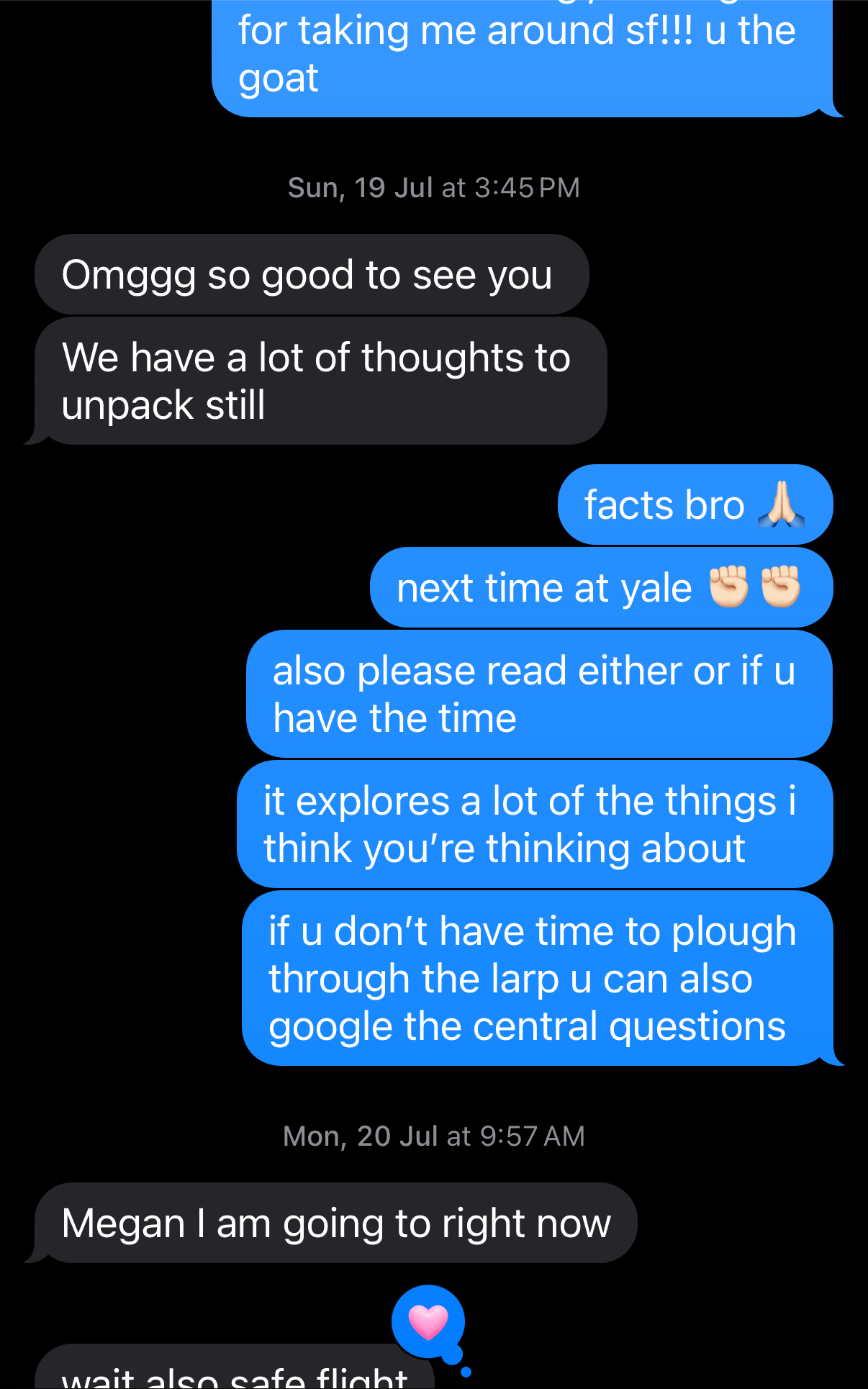
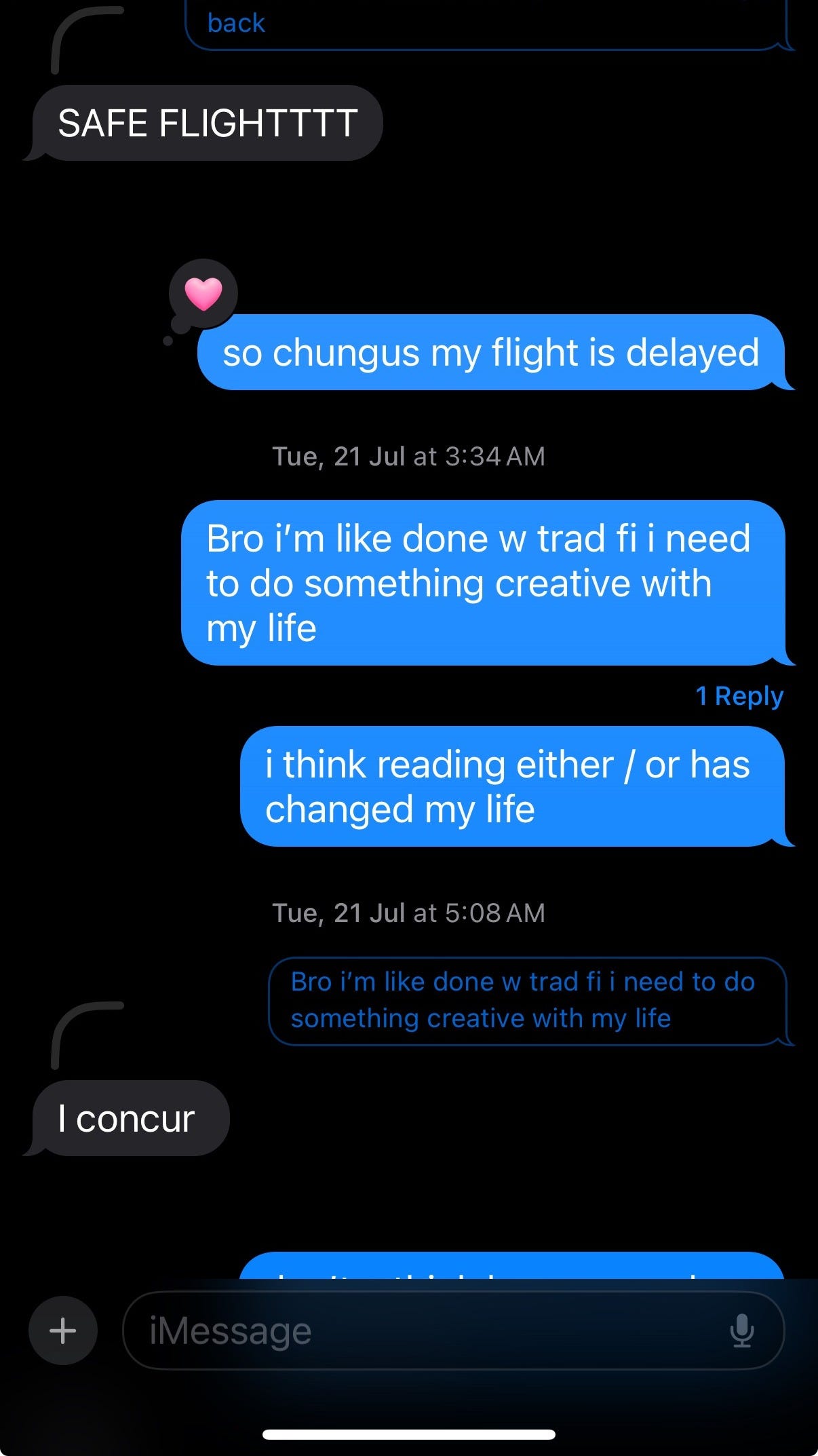
I will now do the “plough[ing] through the larp” for you.
Either/Or is structured as a confrontation between two ways of living. The first is represented by “A,” Kierkegaard’s aesthete, who organizes his life around novelty, intensity, and possibility. The second is represented by Judge William, who argues for an ethical life organized around choice, continuity, and commitment. Predictably, A is much more entertaining. He seduces women, attends operas, writes some pretty sick aphorisms, gets bored, and then turns his own despair into creative material. Judge William writes extremely long letters telling him to get a grip.
The aesthete is often imagined as a passive dilettante, drifting among pleasures because he lacks the discipline to decide what he wants. But Kierkegaard’s category is slightly more unsettling, where he posits that the aesthetic life is not defined by inactivity; it can be energetic, obsessive, and spectacularly productive, where an individual can throw himself into, say, a project with enormous intensity. What he cannot tolerate is the point at which this intensity gives way to repetition, that moment when an experience stops revealing an exciting version of himself and begins imposing ordinary obligations. He wants to experience everything without being claimed by anything, preserving his options not by standing still but by moving constantly, converting each apparent commitment into another experiment—the “rotation method.” Through this, boredom is avoided by continually changing the way one encounters the world, so that no choice lasts long enough to become binding.
Kierkegaard’s point in Either/Or is this pursuit of possibility produces a kind of dizziness. In the chapter entitled “Diapsalmata,” A repeatedly confronts the instability of a life organized around endless potential: every choice excludes alternatives, yet refusing to choose leaves him suspended in boredom and despair. The aesthete keeps moving partly to escape this dizziness. Each new project restores the feeling of possibility before that can become responsibility. Obviously, this creates a vicious cycle.
Consider the founder who becomes consumed by a new company. He spends a couple weeks building a UGC marketing team, getting Claude to code some sloppy UI/UX interface, and telling everyone that having a traditional j*b is stupid. But once the company has to face the issue of customer acquisition and retention, the slow work of improving one bug at a time, that excitement begins to disappear. He does not necessarily fail because the company is failing. He leaves because the company has become a set of obligations rather than a source of possibility. A few months later, he is announcing a new idea with the same intensity.
Or consider someone who falls in love with the beginning of relationships but not with relationships themselves. He is attentive and creative with dates; he is so emotionally mature and wise at that stage when every conversation seems to reveal a new version of the other person and of himself. But once affection becomes dependable, in the sense that it requires showing up, apologizing, making plans, and remaining interested after the mystery has faded, he thinks of commitment as purely loss of freedom. (He is a loser that just chases that sensation of becoming someone new through another person.)
Judge William offers the alternative: the ethical life. This does not mean becoming a morally righteous, anal piece-of-shit that wears quarter-zips and talks about “settling down.” The ethical person is distinguished by his willingness to choose himself continuously, to let a decision persist after its original excitement has disappeared. For Kierkegaard, commitment is not the expression of some perfect certainty we possess in advance but a process through which an uncertain possibility acquires substance over time. We do not first discover a finished self and then select the life that corresponds to it. We become a self by choosing, accepting what that choice excludes, and choosing it again when we are no longer being rewarded with the thrilling sensation of transformation.
This is really what had bothered me about San Francisco, but it also made me think about New York, where there exists that same refusal to be narrowed by a single life: the lacrosse player who works in private equity, trades crypto on the side, runs a finance meme account, trains for a marathon, and speaks casually about buying an apartment in Midtown. His ambitions are not necessarily insincere. He may genuinely want all of these things. But the accumulation can become its own aesthetic, a way of displaying optionality rather than inhabiting a commitment.
The problem was not that founders pivoted, failed, or changed their minds; sometimes abandoning a company is the only intelligent thing to do. Nor was it that these New York strivers lacked discipline (they are very impressive in their grind, in fact). It was that both cultures could confuse the intensity of beginning with the depth of remaining. The founder collects ideas; the finance bro collects roles, credentials, side projects, and increasingly expensive evidence that he could become several different people. A gap year, a launch video, a new job, a trading account, and a manic month of building could produce the appearance of having chosen without requiring anyone to relinquish possibility for very long. In both cases, freedom becomes a performance of remaining uncommitted: not the freedom to choose a life, but the freedom to keep every life available.
Now I say all this but, quite frankly, the only person I have the real right to comment on is myself.
(For the record, I think a lot of the pieces I write seem to come off as grand indictments of where society is headed. I might come off as having a holier-than-thou tone and an elitist bird’s-eye perspective but the truth is, everything I write comes from a place of introspection. Much of what I have to say to my small audience of subscribers are also reminders I would like to tell myself.)
I have always been proud of the breadth of my interests. I spent all of high school intensely studying Classics, Art History, and Literature. I wrote a play in Latin and planned to study English at Cambridge. Then I serendipitously ended up in the States and took the whole liberal arts schpiel very seriously. I switched from one major to the next, ranging from Economics (despite literally only knowing about supply and demand when I first got to college) to Cognitive Science. I stumbled into finance clubs, was heavily recruiting for IB for a while, became interested in politics and law, all while trying to write more frequently somewhere in between.
Maybe this is embarrassing to admit but I just loved that no single description seemed sufficient. Depending on whom I was speaking to, I could be the English major who somehow ended up in private equity, the finance person who was actually going to not take the offer and try to go into journalism, the prospective lawyer with half-written essays about labubus. Time and time again, I interpreted this resistance to categorization as evidence that I was living expansively.
I had mistaken my own breadth for independence. Because I could see the appeal and absurdity of every path, I imagined myself freer than those who had committed too quickly to one. But my openness also shielded me. So long as I remained a possible writer, possible lawyer, possible investor, possible academic, and possible founder, none of those lives had to survive the indignity of becoming real.
When finance felt dull (as it often does), I could reassure myself that I was really a writer. An artist. A creative, if you will. When writing became difficult, I could turn toward the prospects of creating company and tell myself I was “building” (stealth mode). When that became frustrating, I could imagine law school as the life in which my abilities would finally cohere. I was always moving toward the next account of myself before the current one had enough time to become disappointing. Like Kierkegaard’s aesthete, I did not preserve possibility by doing nothing but by doing many things provisionally.
I accumulated interests, projects, internships, club positions, and possible careers, each offering the pleasure of a new vocabulary and a new version of myself. For a while, this felt so much like momentum. But beginning something is uniquely flattering because it allows ambition to remain abstract: there is almost no distance between what I intend to do and what I imagine myself capable of doing.
None of this means that having diverse interests is a failure of commitment, or that the fulfilled life must be organized around one monastic vocation. Hobbies and genuine curiosities enlarge a life by giving it more ways to encounter the world; provisional identities fragment a life by giving us more ways to escape the demands of the one we are already living. The difference is whether breadth enriches a chosen life or continually provides an exit from it.
Nor does commitment mean remaining loyal to every decision simply because we once made it. Sometimes high agency requires leaving the company, dropping out of pre-med, ending the relationship with an insecure dude, or admitting that a path no longer deserves our time. The question is whether we leave because reality has taught us something, or because it has finally intruded upon the fantasy. A pivot can be an act of authorship but it can also just be a rebranded “rotation method.”
The freedom I admired in San Francisco was the freedom to begin: to reject inherited scripts and make something without institutional approval. But agency becomes real afterward, when the launch video ends and the choice becomes a schedule. A fulfilling life gives possibilities enough time to become experiences, and repetition enough space to turn any sort of work into craft, infatuation into intimacy, and curiosity into knowledge and mastery.
A life without limits may contain every possible self, but it cannot give any of them substance. Choosing one path means losing others, and there is no philosophical and psychological trick that makes that loss unreal or can stop our mind from wondering ‘what if?!’ But that same loss is also what concentrates our energy. When a door closes, a room appears. A fulfilling life is therefore not defined by how many possibilities remain available, but by whether we have allowed one possibility to acquire weight and consequence.
The difficult pill to swallow is that keeping every option open can feel liberating but more often that not, it can also prevent any option from becoming a lived commitment. I’ve come to understand freedom as the capacity to author a life without first being guaranteed that it is the correct one: to choose, to let reality revise the choice, and to remain long enough for possibility to acquire weight.
As a result, fulfilment is not finally discovering a life so perfect that it excludes nothing. Instead, it is accepting that anything worth loving or building will ask us to relinquish something else. The limits of a choice are not evidence that our freedom has failed. They are what allow freedom to become more than fantasy. Without them, I can imagine myself as anything and everything, but none of those possibilities asks anything lasting of me or really changes and affects who I am. A choice is only legitimate when it begins to organize my time, exclude alternatives, and make me responsible for what actually happens next.
Limitation through commitment and decisive choice becomes the vessel that converts freedom from the abstract capacity to do anything into the lived power to do something. We can spend our lives collecting possible selves, or we can consent to the loss through which one of them becomes real.

Shoutout YDS for these sick photos. I will get you coffee in Boston.
Wow so many deft and insightful passages that felt written directly at me 😂 really loved this piece! Did you come up with the phrase “when a door closes, a room appears”? Because if so it’s a banger 👏
This has haunted me for a while and I’m still not over it. When I was in my early twenties, a girl told me and a friend we had so much potential. I couldn’t sleep that night and in the dark I asked my friend if there would be a day potential wasn’t enough. We hid in our potential possibilities, wore them like garments, until they are stripped away from us to reveal the only things we truly committed to